

Pride in Horror Article: The Scary, Entertaining, and Sometimes Queer World of Japanese Yokai

Japan is famous for its cherry blossoms, serene temples and gardens, and anime culture. Less well-known, however, is its rich tradition of yokai (also spelled yōkai), the collective name for supernatural entities. Although commonly translated in English as “demons,” that term does not capture their enormous variety. Yokai represent a wide range of supernatural occurrences that includes ghosts, goblins, witches, demons, anthropomorphic household items, strange hybrid animals, mysterious lights, and more.
Similar to creatures of legend in other cultures, the behavior of yokai varies from helpful to mischievous to sinister. Some are closely related to either Shinto gods or Buddhist monks, and may have originated as divine or semi-divine beings. They can be tricksters or shape-shifters, capable of transforming into human guise to fool the unwary.
Let’s look at some of the more popular types.
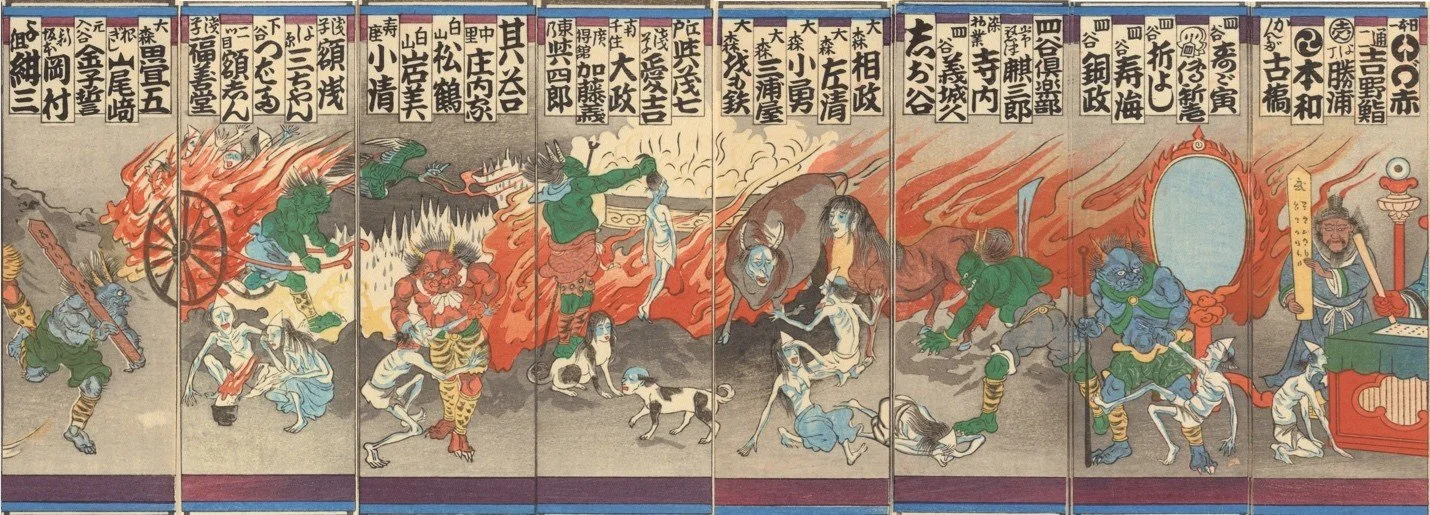
Eight senjafuda from a series representing souls and ogres in hell, Gertrude Bass Warner Memorial Library, Japanese Art, Special Collections and University Archives, University of Oregon Libraries, Eugene, Oregon - This work is licensed under a Creative Commons Attribution-NonCommercial-Sharealike 4.0 International License to Glynne Walley and the University of Oregon, 2019
Yurei
Yurei are the spirits of the deceased who have not found peace in the afterlife. A type of ghost, they often appear as ethereal figures with long, dark hair, dressed in funeral white, and typically haunt particular locations or individuals. Western audiences will recognize yurei from The Ring and The Grudge movies.
Kappa
Kappa appear as human-like turtles or reptilians that inhabit rivers and ponds. A dish atop their heads holds water that is the source of their power. Although often portrayed as adorable green animals, they have a reputation for luring people—especially children—to be drowned. The movie Teenage Mutant Ninja Turtles popularized a modern interpretation of kappa in the 1980s.
According to the University of Oregon Libraries, kappa were metaphorically associated with male-male sexuality in early modern Japan. Although I can’t find additional confirmation of this historical claim, it’s interesting that Sarazanmai, a Japanese anime TV series about kappa, incorporates a gay story line. Three schoolboys get transformed into kappa after accidentally destroying a kappa statue, and one of the boys develops a crush on his kappa friend. In traditional folklore, kappa have a fondness for butts and cucumbers. I don’t think I need to point out the obvious symbolism!
Yamauba
The yamauba, an old crone in tattered garb who lives in the mountains, can be benevolent or cannibalistic. In one legend, she catches children and nurses them for a while before devouring them. She shares characteristics with mythical forest-dwelling women in Western and Slavic folklore such as Baba Yaga and the witch in “Hansel and Gretel.”
A Cross-Dressing Yokai
The 18th-century scholar, poet, and ukiyo-e artist Toriyama Sekien produced illustrated books of yokai that became quite popular. In his second collection, The Illustrated One Hundred Demons from the Present and the Past, published in 1779, he depicts a male yokai dressed up as a girl that he identifies as an ōkaburo. This ōkaburo wears a chrysanthemum-patterned kimono and calls himself “Chrysanthemum Boy” (even though he is reputedly 700 years old). Sekien likely intended his ōkaburo to be a pun referring to homosexual brothels in which young boys dressed up as kamuro (typically a young girl apprentice to a courtesan). The chrysanthemum was used as a symbol for homosexuality since the shape of the petals supposedly resembles an anus. The word for chrysanthemum is sometimes used today as a slang term for anus in China and Japan.
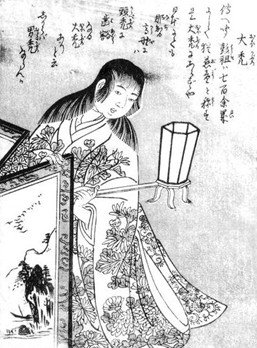
Illustration of an ōkaburo by Toriyama Sekien – public domain
Yokai Characteristics and Gender Fluidity
Specific features or behaviors of different yokai tend to evolve over the centuries, so it can be tough to pin down definitions. Take the long-nosed demons known as tengu, for example. The concept likely originated in China as the tiangou, or “heavenly dog,” a creature that ate the moon or sun during eclipses. In Japan during the Heian period (794-1184), illustrations depicted a dog-headed creature with supernatural powers. Due to its ability to fly in the heavens, the tengu later became a human-bird hybrid with wings and a beak. Eventually, the face became human and red, while the beak morphed into a long nose. At one point in its history, the tengu tormented and tricked humans, especially monks. But later, as they assumed swordsmanship and martial arts skills, tengu helped humans by teaching these skills to samurai warriors. These shifting characteristics are emblematic of many yokai.
Anything, it seems, can take on the spirit of a yokai, especially very old objects. An abandoned instrument called a biwa bokuboku sits alone in a room and plays sad music, sometimes even dancing through an empty house making music as it goes. One-eyed, one-legged umbrellas known as kasa-obake offer a more comical approach. Perhaps the most unusual of these objects is the nurikabe, an invisible wall that impedes or misdirects travelers at night.
Yokai are a common element in Japanese manga and anime, such as Shigeru Mizuki’s Kitaro yokai boy series and Hayao Miyazaki’s Spirited Away movie. Many iconic yokai, such as kitsune (fox spirits), are legendary shapeshifters. Because they can change their form, gender, or appearance at will, they are often seen as symbols of gender fluidity and non-binary identity. They can serve as a metaphor for the social outsider, thus appearing regularly in manga and anime to explore queer themes.
Where the Yokai Dwell
In Japan you can enjoy yokai all year long. Kyoto features the Night of One Hundred Demons festival between September and December, with demon parades on three separate nights. At the foot of Mount Oe in Fukuchiyama sits the Japan Oni Exchange Museum, a demon-themed museum and site of Shuten-doji, the legendary demon that terrorized Kyoto. Zenshoan Temple in Tokyo occasionally presents a Yureiga Ghost Paintings Exhibit during August. The Yokai Art Museum on Shodoshima Island displays over 800 yokai from around the world. Near the Nasu hot springs, you can see the Sessho-seki “killing stone” that is rumored to kill anyone who touches it and was the subject of a famous Noh play. The area is known for its volcanic activity, constantly producing poisonous gases, which might explain the origin of the myth. Nearby, there is a shrine dedicated to the nine-tailed fox Tamamo-no-Mae, the shape-shifting kitsune whose corpse transformed into the Killing Stone. These are just a few of the many activities and legendary sites you can visit all across Japan.
Whether you prefer being scared or being amused, yokai offer an endless variety of entertainment for horror fans.
About the Author
Jon O’Bergh is a musician and author of three horror novels. His latest novel The Yōkai is currently offered for free in weekly installments on Substack. Out Front Magazine described his novel Shockadelica as “a book that must be on your to-read list,” and Aurealis Magazine named it “Reviewers’ Pick of 2022.” He has also released over a dozen albums in a variety of styles, including the critically acclaimed album 13 Witches.