

Pride in Horror Book Review: The Burning Kingdoms Trilogy by Tasha Suri

Genre: Fantasy
Age: Adult
Format: Hardback
I have been a fan the Burning Kingdoms books since The Jasmine Throne first came on my radar in either 2021 or 2022. I was finally able to get a copy of the final entry in the series in hardback recently and excitedly devoured it. Tasha Suri’s trilogy, based on Indian mythology, is an epic fantasy enthusiasts should check out, especially if they are looking for a series featuring LGBT+ characters and in a non-European setting. I will try to avoid spoilers for all three books throughout the review but will be reviewing all three together, so some minor ones may be peppered throughout.
Set in the Parijatdvipan empire, Suri’s trilogy follows Priya, an Ahiranyi woman who starts the series working as a servant but has magical abilities, and was once being trained to wield nature itself as a weapon. She initially meets Malini, a member of the Parijati royal family, when Malini is punished and sent to Ahiranya for refusing to be burnt alive by her brother, Chandra, the emperor. Over the course of the series, the two women must find a way to help themselves, their people, and eventually the entire empire while navigating their complicated feelings for one another.
Priya and Malini are the beating heart of the trilogy. While their romance is central to the story, it is as twisted and confusing as it is sincere. The nature of their differences makes it hard to predict how things will end for them. While it is clear that they grow to deeply love one another, the other forces at work influence how they can express their love. There are doubts if the love is true at various points, and the series explores how love and hate can become interwoven, questioning if forgiveness can ever truly be given. The fact they are both women is another conflict they must face. One of the reasons for Malini’s exile is her brother realising she was uninterested in men and preferred women. The religion of Parijat forbids such unions, and Chandra is nothing if not a fundamentalist, with rigid views on how women should act. Priya’s homeland was more accepting of such relationships until they were absorbed into the Parijatdvipan empire. She also fears that the other Ahiranyi will assume she is merely a pawn of Malini’s if they find out how she feels for the Parijati woman.
In addition to their romance, they are both excellent characters. Priya is a skilled fighter, even without her magic. She is a determined warrior who is often underestimated due to her sex and small stature. Her magical abilities make her even more terrifying to others. Yet she is constantly struggling when it comes to ruling or trying to play at any politics. Her nature is not well suited to that world. Malini, on the other hand, is as clever as she is subtle. She plays on people’s assumptions and is a master manipulator. While she can be warm and open, she relies on masks to hide how calculating and ruthless she truly is. She eventually learns to fight herself, but Malini’s greatest strengths are always her adeptness at knowing how to play to a room and use whatever she can to achieve her own goals.
These two amazing women are the leads of the series and readers are introduced to many other fantastic characters over the course of the trilogy. There is the kind yet cunning, politically savvy Bhumika. She and Priya are not blood sisters but are bound by their time serving in the Ahiranyi temple as children, their devotion to Ahiranya, and their magic. Bhumika is caught in a difficult position, married to a Parijati regent and pregnant at the start of the trilogy. She must deftly placate the ruling Parijati while trying to aid the Ahiranyi, concealing her true feelings from both her husband and her closest friends. Bhumika grows into a ruler in her own right and undergoes many great trials in an attempt to protect her people from the threats within and without Ahiranya. She may be my favorite character in the trilogy! Rao is another supporting character as an Aloran prince brought up for most of his life with Malini’s family. His love for her other brother, Aditya, drives him but he recognizes that Malini is the best choice to rule over Parijatdvipa. He must face battles and war but also confront his own feelings and finally choose his own destiny, a seemingly impossible feat for someone whose fate is their given name. There are so many other characters for readers to resonate with, like wise sage Lata, snarky Sima, vengeful, driven Ashok, and the precocious Rukh. Suri fills her world with a wonderful array of well-developed characters.
While the series is not horror or classified as dark fantasy, some elements of the magic and gods in the story creeped me out. The “rot” is a terrifying plague that transforms humans into bizarre, plant-human hybrid creatures in slow agony. Some characters are described with leaves sprouting from their heads, greenery visible under their skin, and other plant life bursting through them at various points. The rot-riven are treated similarly to lepers in our world, being excluded or chased from their homes as it can be passed to others. The disease is impossible to cure and can be slowed only with magic. The rot can also impact plant life, rendering trees or fields into stinking, meat-like inedible tracts of land.
The religions of Parijatdvipa may fill some readers with dread in their resemblance to real world faiths. Many of the antagonists in the trilogy are fundamentalists who use their religion to torment and subjugate others. If the worshipers are bad, the gods themselves may be worse! The Ahiranyi yaksa, the Parijati mothers of flame, and the Aloran nameless are all deities that use their faithful rather cruelly. The Ahiranyi temple children, like Priya and Bhumika, are expected to travel through the deathless waters, risking their lives to acquire their magic and are treated as monsters by those outside, and even within, Ahiranya. The yaksa can then steal the bodies of their sacrificed dead and see the rot as a good thing, making the world more like them. They have no fondness for humans beyond the veneration they can offer. The mothers of flame are often worshipped by burning young women alive, willing or not, to show their devotion. These burnt women can also generate a magical fire that can be used as weapons. The fire born when one of the faithful is burnt is more potent, but fire rendered from the willing and the forced is still a useful fatal tool for those who seek power. While the nameless seems to be the least demanding, the descriptions of the void where the nameless dwells and the sacrifices also made by nameless priests are no better than what is expected by the yaksa or the mothers.
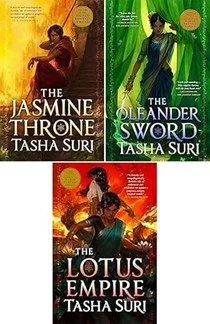
The world is very well constructed and each of the separate lands and peoples of Parijatdvipa are interesting. Their ties to one another change throughout the series and I wish we spent more time in some of them. However, that is the nature of story and sometimes authors must focus on specific areas lest the story lists into a travelog and not a novel! Though, I do think the map is rather lacking in detail and scope. Compared to other fantasy series with beautiful maps, this series does not really have one. This is a minor quibble and something that does not negatively impact the story. However, the covers are lovely, featuring Priya on all three and adding Malini as well on the final book.
Overall, I greatly enjoyed each entry in the trilogy and The Lotus Empire was probably my favorite of the three. It is impressive that she stuck the landing since conclusions are often the hardest part of finalizing a series. Suri managed to complete this epic in a satisfying way that felt neither cruel nor overly optimistic. The other books are excellent as well but there are some parts that felt like they dragged. Regardless, The Burning Kingdoms series was a great fantasy read and a wonderful option for LGBT fantasy fans as well as those looking to read great stories by female authors of color.
Rating: A-
Purchase at
Review by Dee
Twitter & Bluesky: @SirenofScience
I purchased these books from Amazon.